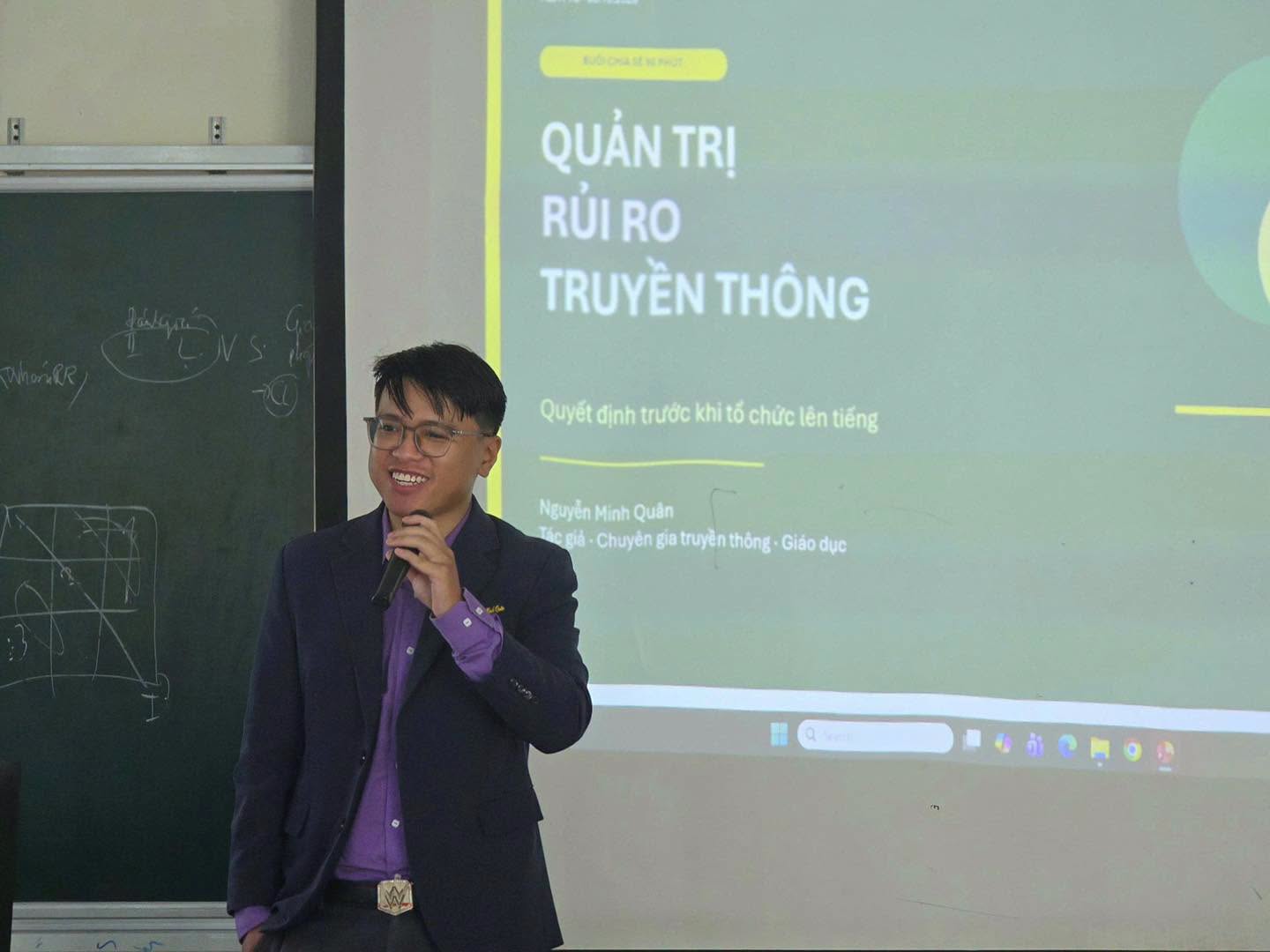
On Saturday, October 3rd, 2026, students of the Applied Master of Business Administration (MBA) Program, Cohort 32B, Foreign Trade University, attended a special workshop on the topic “Media Risk Management,” held within the framework of the Risk Management course.
The workshop was attended by Associate Professor Dr. Nguyen Thi Hoa Hong – a lecturer at Foreign Trade University – College of Business and the instructor in charge of the Risk Management course. On the expert side, the program was honored to welcome Mr. Nguyen Minh Quan, MA – Communications and Education Specialist and Director of The Good King Language Center, who brings 15 years of professional experience in the banking and education sectors. Also in attendance were more than 20 students of Class MBA32B, comprising officials, managers, and business owners currently working across a wide range of fields.
Within the framework of the program, students were introduced to a number of issues currently confronting corporate communications, including distinguishing AI-generated images from authentic ones from a managerial perspective, drawing a clear distinction between communications and marketing, identifying insufficiently substantiated messages, and using AI in a controlled manner.
A distinguishing feature of the workshop was that all knowledge was placed within vivid, real-world scenarios. Students directly proposed approaches to handling each case, shared experiences drawn from their own professional work, and analyzed and exchanged views with the expert to identify the most suitable solutions.
Through these scenarios, students honed their ability to recognize an insufficiently substantiated message, pose the necessary verification questions, and make appropriate communication decisions, choosing among three options: release, withhold, or release with conditions.
Notably, the expert introduced a six-step process for handling communication crises, comprising: Objective, Evidence, Audience, Decision Authority, Worst-Case Scenario, and Accountability. These elements provide managers with a further basis for comprehensively assessing a situation, enabling them to act more proactively before making communication decisions.
Concluding the workshop, the emphasis was placed not only on how to handle a specific communication scenario, but also on the mindset of “controlled choice” – that is, verifying information, weighing risks, and being prepared to take responsibility for a message before releasing it to the public.
The session forged an effective connection between classroom knowledge, practical experience, and expert perspectives, thereby equipping students of the Master of Business Administration (MBA) Program with an additional practical competency on their path to becoming future business leaders.